


Article
Transit-Oriented Development
For the Fraser Valley and other regions, getting there may not necessarily be half the fun
2024 Spring
It’s one of those idealistic notions so beloved of city planners, urban design theorists and well-meaning governments, that soon, many more of us will be living in amiable, walkable communities that are so convenient we won’t even want to drive our cars.
On the drawing board and in sparkling photos of exemplar neighbourhoods these communities are densely populated and close-knit, dotted with parks and open spaces and connected by narrow, pedestrian-oriented streets that are lined with all the shops, services, and sometimes even the workplaces that people in the neighbourhood want. Critically, they are also ‘transit-oriented,’ a factor that makes the arrangement more sustainable because people can easily connect to the broader region, again without getting into their cars.
It’s a laudable aspiration, these Transit-Oriented Areas (TOAs), and if you talk to planners, politicians, or academics in the Fraser Valley, there seems to be a shared commitment to make the dream a reality in a surprising number of locations. The problem – as with so many things in a growing metropolis that is both congested and sprawling – is that getting there won’t be half the fun.
The Big Picture
First, a massive change in the general form of development in the Valley is coming, whether we like it or not. The combination of population expansion and tightening physical and economic constraints makes that inevitable – and in many ways, desirable.
Second, the change is already well underway. Developers, planners, and politicians in the Valley and elsewhere in the Metro region have been working together for years to increase housing density and affordability, even as they honour the protected status of natural and agriculture land in their midst.
Third, senior governments have come down hard, with the Federal Government saying it will withhold funding from jurisdictions that don’t densify, and the Provincial Government imposing new legislation that massively increases the potential to develop more density, even if it won’t necessarily increase the pace.
Finally, there are incredibly sticky points of resistance to this transformation. Most obviously, there is a shortage of funding for the transit that is crucial to transit-oriented development. But there is also the inertia that is built into the layout of our current homes, neighbourhoods, and infrastructure. And there are the enduring cultural habits of the people who live here. In the words of Dr. Afia Raja, head of the Department of Planning, Geography, and Environmental Studies at the University of the Fraser Valley, “North Americans go to the gym in their cars.” Even aside from the challenges of remaking the landscape, it could take years for citizens to also revise a whole set of personal habits.
TransLink’s Six “D’s” of TOD Communities
- Density
Increase available supply - Destinations
Coordinate land use and transportation - Distance
Ensure a well-connected street network - Design
Include great spaces for people - Diversity
Ensure a mix of uses - Demand Management
Discourage unnecessary driving


Build it or not, they’re coming
Beginning on the population question, Andrew Ramlo, who, as Vice President of Intelligence crunches data for the sales and marketing force at the Rennie Group, points out that the Surrey Official Community Plan has, until recently, been working on the assumption that the municipal headcount, which is currently just under 700,000, would rise to one million by 2060. But a recent update from BC Statistics shows the municipality is now expected to hit that figure by 2046. As Surrey’s general manager of Planning and Development, Don Luymes, puts it, there is no room to accommodate that level of growth using the old patterns; no room, for example, for 40% more roads. “It would be a good thing to have a more compact and efficient form.”
“Fraser Valley communities are rightfully credited with doing more than their share to fill the need, including working hard to build transit-oriented neighbourhoods.”
Provincial Housing Minister Ravi Kahlon also notes that the population surge – and critical housing demand – isn’t a problem that lies somewhere off in the future. He recently told the Surrey Now-Leader, “We have people that are underhoused. We have people that are living 12 people, 13 people to two-bedroom suites, and the need is great.”
The housing shortage, and especially the dearth of affordable housing, is hardly a surprise in the region. And Valley communities including Surrey and the Langleys are rightfully credited with doing more than their share to fill the need, including working harder to build transit-oriented neighbourhoods, or at least neighbourhoods that would meet the definition if transit was already in place.
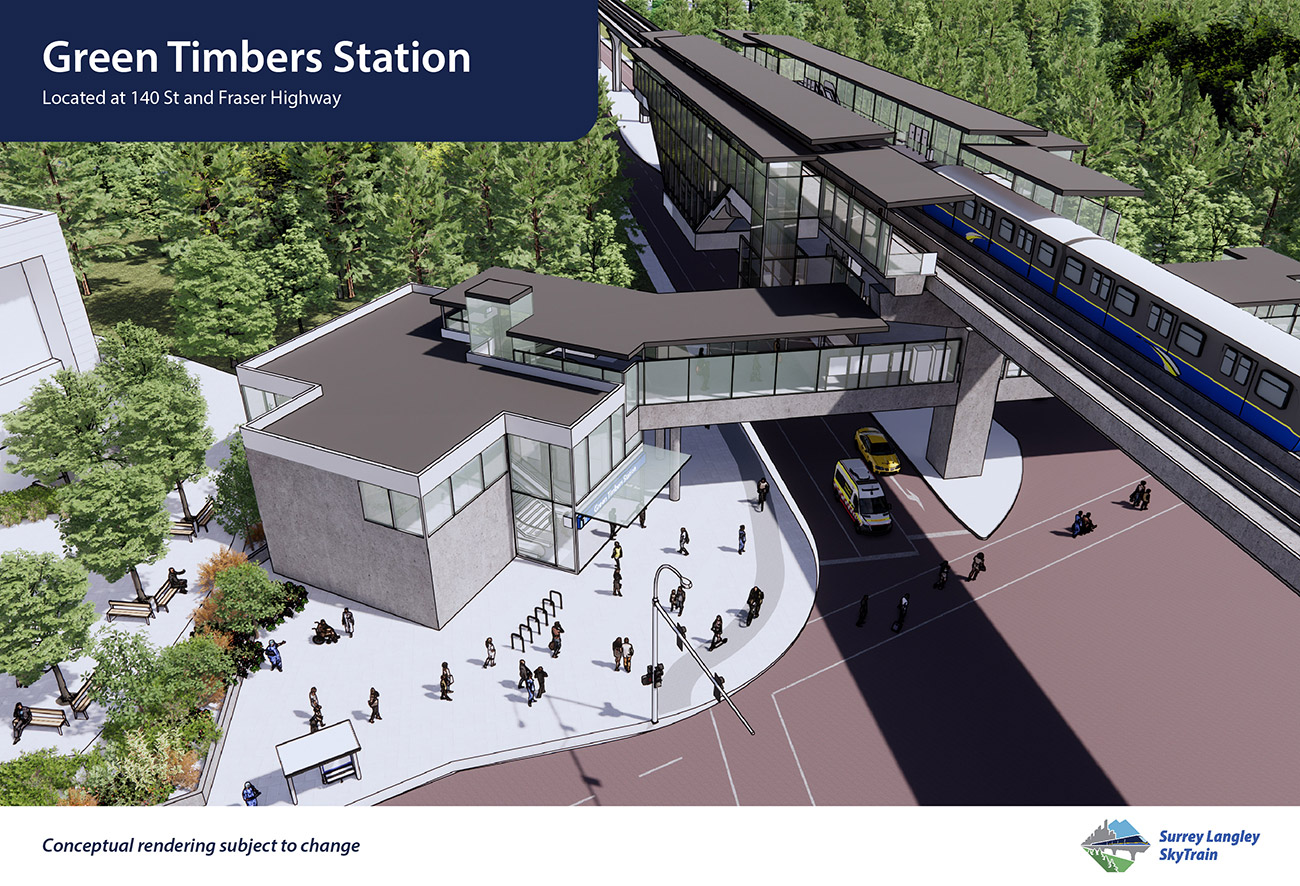
Langley City Mayor Nathan Pachal, a cyclist who doesn’t own a car, says flatly that, even before the anticipated arrival of the SkyTrain extension, his community is already “as transit oriented as can be.” He adds, “it’s not Metrotown, but Langley City is a compact 10 square kilometres with excellent transit service” arrayed around a walkable commercial district that boasts a 120-year history on the Langley prairie. The City is also working hard to densify the areas around Willowbrook and the Fraser Highway where there will be SkyTrain stations, once the extension finds funding.
Langley Township Mayor Eric Woodward says his municipality is also ahead of the curve. Pointing to the high-density strip along the 200 Street corridor, he says, “We’re doing quite a bit of walkable development in anticipation of transit.” The current lack of transit is a sore point for Woodward, who notes that there are a million people living south of the Fraser River. “Given what we remit in property taxes [towards TransLink], it’s galling to see the biggest current transit expenditure – the Broadway Line – is centred in the community that already has the best service in the region.” Even in lower-density developments on the urban fringe, where there is little transit now and no serious improvement expected any time soon. We build the housing that makes sense,” he says, implying a denser, more affordable form.
“Given what we remit in property taxes, it’s galling to see the biggest current transit expenditure – the Broadway Line – is centred in the community that already has the best service in the region.”
Eric Woodward
Mayor of Langley Township
Surrey’s Luymes agrees. “There has been a lot of discussion in planning circles lately about the missing middle, the medium-density housing (townhomes and small multi-family buildings) that fall between sparse, car-oriented, single-family suburban model and mid- or high-rise towers,” he says. “If you’re looking for good examples of the missing middle form, you’ll find the highest concentration in the region among new developments in Surrey and other Valley communities.’
So, if Valley communities have already accepted the advantages of planning more compact, walkable, easily serviced communities – suitable for transit, should it come – you might well ask why the Provincial Government moved so dramatically last fall to pass in legislation that:
- requires local governments to allow for increased density on lots currently zoned for single family homes or duplexes;
- limits the use of public hearings for zoning-compliant residential projects;
- relaxes municipal parking regulations;
- requires municipalities to designate land within 800 metres of rapid transit stations and within 400 metres of major bus exchanges as transit-oriented development areas; and
- sets heights and densities within those areas that, functionally, cannot be denied (see inset).
Taken together, the Provincial Government estimated that the changes in its single-family zoning legislation, Bill 44, could make room for 130,000 new small-scale multi-unit homes in the next 10 years, while the height and density upgrades that Bill 47 permits near transit nodes could allow an additional 100,000 units.
Don Luymes is sympathetic to the thrust of these changes, acknowledging that the system needed a nudge. “I applaud the province’s intent. They were trying to shock the system.”
Turning drivers into passengers
North American city planners have spent the better part of a century designing and building cities to make them work for people who drive automobiles, with highways and byways, wide streets with narrow sidewalks and maze-like, car-oriented suburban neighbourhoods that often have no sidewalks at all. It’s true that most people would like to be a short walk to a grocery store and a coffee shop, but nobody wants to actually live beside a 7-Eleven, so planners have segregated the city – housing here, services there, workplaces somewhere else. That didn’t just make room for cars; in most cases, it forced people to drive – and to park. So, we wound up with ever more roads and bridges and thousands of extra acres of blacktop for parking spots that served to separate everything even further.
“We have required too much parking,” Luymes says (a 2021 University of Calgary study estimated that there are between 3.2 and 4.4 paved spaces for every car in Canada) and that also has made housing even less affordable. He notes that the current cost for an underground parking spot is $100,000 – a huge premium on the price of an entry-level condo.
But no sweeping government intervention can ever come without unintended consequences. In this instance, for example, Luymes points out that the regulations requiring very high-density buildings within 200 metres of SkyTrain stations and Bus Exchanges, also permit lower density forms between 200 and 400 metres. And because land and project costs are high in the inner ring, lots of developers are instead looking to develop less-expensive, lower-density product (e.g., six-storey woodframe buildings) in the outer ring, where it’s cheaper to assemble property. The result, Luymes says, is an invitation to a perverse kind of sprawl; in the short term, we could wind up not with walkable, well-serviced communities clustered close to transit, but rather with donut-shaped density nodes that have nothing in the middle but a bus exchange or a SkyTrain station. It could be a promising start; the centre ring could be expected to fill in over time. But it could also be chaotic, and counterproductive, in the meantime if all the early residents still need cars and there isn’t enough parking.


“There is no room to accommodate anticipated levels of growth using the old patterns.”
Don Luymes
GM of Planning and Development, Surrey
This also comes back to the crunchy question of transit. Sarah Ross, TransLink’s Vice President of Planning, is unsurprisingly bullish about transit south of the Fraser, where ridership – which is still lagging in other parts of the region – is currently up more than 20% from pre-pandemic levels. Ross says, “The increase is outpacing population growth,” partly because TransLink has also rearranged its offering to increase services in the southeast region by 25%.

Ross, who also spoke positively about the high concentration of “missing middle” housing in the Valley, says, cautiously, that “people have oversold density as the definition of transit oriented.” It’s not enough, she says, to have “a big, tall tower next to a SkyTrain station.” You also need the services to allow the residents to walk for a coffee or a jug of milk – and to get their kids to school.
Ross treads lightly on that last point, managing demand, saying, “You can’t blame anyone for driving if a community is designed around driving.” She, for example, describes herself as a Vancouverite who makes most of her trips around home on an electric bike. “But it’s not because I’m a purist; it’s faster and I don’t have to worry about parking. It’s just that kind of neighbourhood.” It winds up, over the long term, being a build-it-and-they-will-come challenge, she says, adding, “People will make the best choice themselves.” But, “when communities were built as auto-oriented, it takes a long time to transition away. We’ve got a lot of catching up to do.”
As for her transit planning responsibilities, she says, “We see the need for significantly more investment in the Valley and we’re working every day to get ourselves in a financial situation to increase service.”
That, then, throws the spotlight back on senior levels of government. In the words of Andy Yan, Director of the City Program at Simon Fraser University, “It you’re mandating density, you also need to mandate the transit.”
Having recognized the crisis, having been directed – fairly forcefully – toward a solution, we’re now all looking at what will undoubtedly be a bumpy time of transition. Now, we get to wait and see if we’re going to have to make that transition on our own or if there will also be a new round of transit-oriented help.

Richard Littlemore is a Vancouver journalist and writer whose work has appeared in the Vancouver Sun, BC Business, BIV, amongst other publications.
Issue 2 | 2024 Spring

Planes, Trains and Automobiles
BC’s housing strategy depends on infrastructure as much as inventory. Bringing all levels of government together to build it may be Minister Rob Fleming’s biggest challenge.
more >
Transit-Oriented Developments
For the Fraser Valley and other regions, getting there may not necessarily be half the fun.
more >

The Case for Regional Rail
A regional rail network could cut travel and commute times by up to 50% or more–but is it worth the price tag?
more >
ADVOCACY
Political Liaisons
FVREB meets with MLAs in Victoria as part of BCREA’s Government Liaison Days.
more >
From the CEO
Baldev Gill
Building Momentum Together
The clock is now ticking for BC’s housing strategy.
more >
Insight
Brendon Ogmundson
Generations Apart – Housing Affordability Then and Now
Brendon Ogmundson on the new generation gap.
more >
TRENDING
The High Cost of Being World-Class
When it comes to Top-10 lists, be careful what you wish for.
more >
Last Word
Patrick Condon
The housing affordability crisis is really a land affordability problem
Why didn’t adding so much new housing supply lower prices?
more >