


Article
The Case for Regional Rail
2024 Spring
If you live in Metro Vancouver, you know that our region is making progress when it comes to expanding transit and enabling sustainable modes of transportation. Less than 40 years ago, the region didn’t have any rail rapid transit. Today it has a network of nearly 80 km that will soon grow with the additions of SkyTrain’s Broadway extension on the Millennium Line and the Surrey-Langley extension on the Expo Line.
SkyTrain is not enough
That’s commendable growth, however, there is still a long way to go. TransLink has stated that it wants to see parity between sustainable modes and driving by 2050. The ratio is currently over 3-to-1 in favour of driving—and between driving and transit, it is 5-to-1. The reason for this is simple: transit times for most trips are simply not competitive with driving.
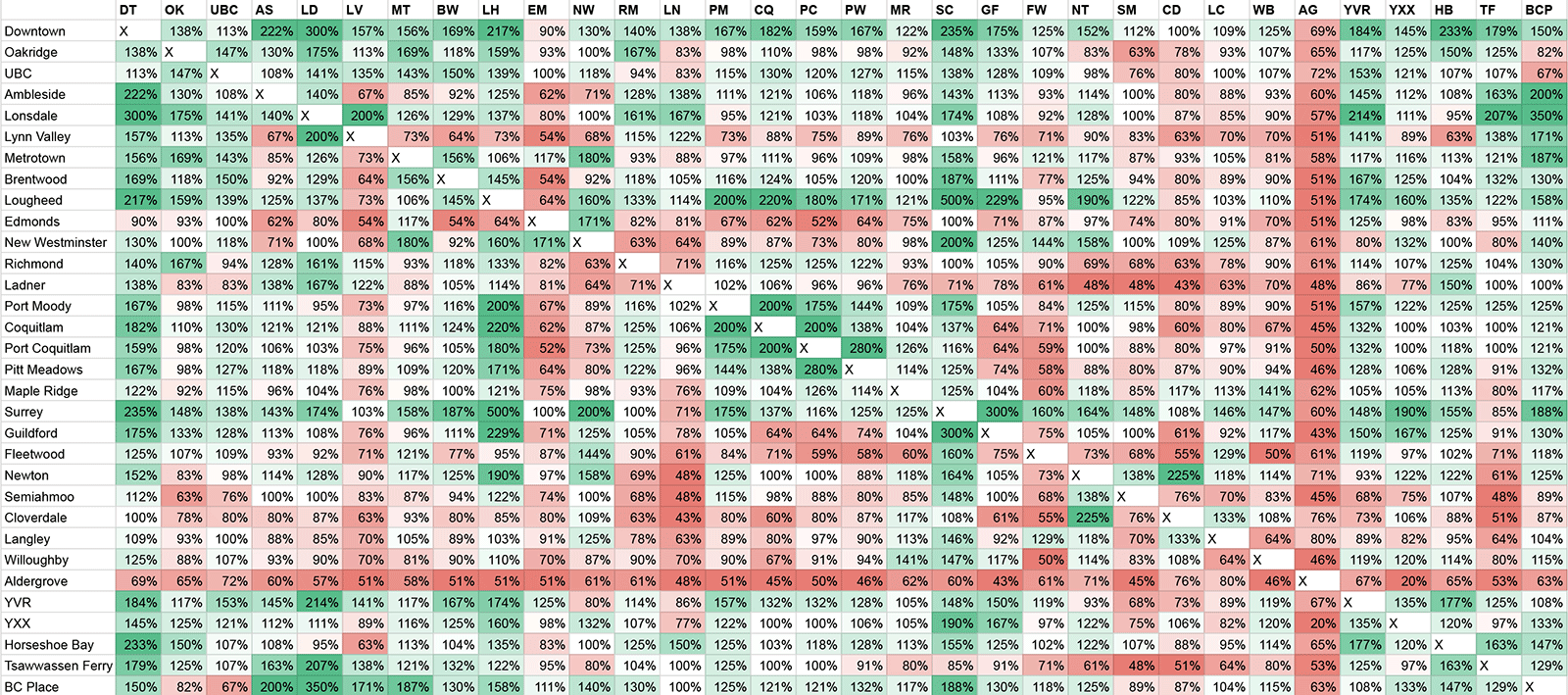
Figure 1 compares travel times between various regional centres. Green cells represent faster travel times using transit, and red cells represent faster travel times by driving.
FIGURE 1 – CURRENT TRAVEL TIMES BETWEEN VARIOUS REGIONAL CENTRES

There are only a few trips where transit is faster than driving (green cells). For the most part, it is a sea of red. And if you look closely, this diagram tells us something further: that rapid transit alone isn’t enough to achieve parity. Consider at any of the trips from downtown Vancouver to destinations on the Millennium Line (Brentwood, Lougheed, Port Moody, and Coquitlam). They are all red. That’s because a transfer is required at Commercial-Broadway Station. Although SkyTrain competes well for trips that run directly on its path through urban areas, it starts to fall behind when a trip requires a transfer or when it runs parallel to a freeway.
FIGURE 2 – TRAVEL TIMES WITH REGIONAL RAIL BETWEEN VARIOUS REGIONAL CENTRES
Regional Rail Solution
If we want transit to achieve parity with driving, regional rail is the missing piece. Virtually every large city in the world where more people use transit than drive has a regional rail system. What exactly is regional rail? A regional rail system is designed to connect an entire region using faster trains (typically over 100 km/hr) and with stations spaced further apart (typically over 3 kms between stations). In contrast, rail rapid transit systems, such as SkyTrain, meant to connect major local hubs, are typically limited to a top speed of 80 km/hr and have stations every kilometre or so.
Regional rail is not the same as commuter rail. The key distinction is that regional rail service runs all day in both directions whereas commuter rail systems, such as the West Coast Express, only have trains enter in the morning and leave during the evening. Regional rail systems are therefore a much more reliable form of transit, serve a far greater variety of trips, and typically move much larger volumes of passengers.
“Transit times for most trips are simply not competitive with driving.”
With trains that can travel at speeds of up to 160 km/hr (far faster than even freeway speeds), regional rail trips can be far shorter than even the least congested drive. It also means that if a transit trip requires a transfer between rapid transit and regional rail, it is still usually faster than driving. Figure 2 shows a comparison of trip times between different regional centres if comprehensive investments in regional rail and rapid transit were to be made. The difference is virtually night and day, with the majority of transit travel times now competitive, if not superior, to driving (green cells represent faster travel times using transit, red cells represent faster travel times by driving).
Yes, a regional rail network would not come cheap—estimates put the cost at upwards of $10 billion. But given the explosive population growth expected in our region over the next decade and the growing affordability crisis, can we afford not to do it? Beyond the benefits of strengthening connections and opportunities between regions, it’s a long term investment that seems absolutely crucial if we are to achieve environmental sustainability and economic equity for future generations.

Lee Haber is an urban and transportation planner and the Director of Strategy and Partnerships at Mountain Valley Express. This piece originally appeared in the Daily Hive.
Issue 2 | 2024 Spring

Planes, Trains and Automobiles
BC’s housing strategy depends on infrastructure as much as inventory. Bringing all levels of government together to build it may be Minister Rob Fleming’s biggest challenge.
more >
Transit-Oriented Developments
For the Fraser Valley and other regions, getting there may not necessarily be half the fun.
more >
The Case for Regional Rail
A regional rail network could cut travel and commute times by up to 50% or more–but is it worth the price tag?
more >
ADVOCACY
Political Liaisons
FVREB meets with MLAs in Victoria as part of BCREA’s Government Liaison Days.
more >
From the CEO
Baldev Gill
Building Momentum Together
The clock is now ticking for BC’s housing strategy.
more >
Insight
Brendon Ogmundson
Generations Apart – Housing Affordability Then and Now
Brendon Ogmundson on the new generation gap.
more >
TRENDING
The High Cost of Being World-Class
When it comes to Top-10 lists, be careful what you wish for.
more >
Last Word
Patrick Condon
The housing affordability crisis is really a land affordability problem
Why didn’t adding so much new housing supply lower prices?
more >