

INSIGHT
As We Go Up, We Go Down: The Changing Tides of Immigration in Canada
2025 Spring
In 2022, the Canadian government sought to boost population growth by dramatically raising its target for permanent residents to Canada from 300,000 people per year to 500,000 people per year in a clunky attempt to fix a short-term problem – labour shortages – with a long-term solution. Lost in the shuffle, however, were the inflows of non-permanent residents, mostly the temporary foreign workers and international students that come to Canada without the goal of necessarily staying long-term or becoming a citizen. Also missing from that plan was any strategy to mitigate the consequent pressure on housing, particularly the massive influx in demand for rental units. As a result, rent prices across Canada soared, and now the Canadian government is aiming to engineer the largest decline in the Canadian population since the Confederation of Canada in 1867. This ambitious goal could have significant implications for the BC economy and housing market, though probably less so for the ownership market.
Since 2021, the population of BC has grown by an astonishing 546,000 people. Because BC has very little organic population growth (e.g. births minus deaths), nearly all of that population growth comes via immigration. Indeed, immigration is what makes our economy run and what makes BC the wonderfully multicultural society we all enjoy. However, virtually all agree that population growth in the past few years has far exceeded what might be sustainable or desirable in the short-run, and perhaps far too much of our population growth is due to an influx of non-permanent residents, typically comprised of international students and temporary foreign workers. Indeed, non-permanent residents accounted for close to 60% of total international immigration since 2021, double its historical 30% share. These individuals predominantly rent their accommodations, which has placed substantial pressure on the already squeezed rental markets in larger BC cities such as Vancouver, Burnaby, Surrey and Victoria. Further, average rents in the Lower Mainland are up more than 20% since 2021.
Rental market relief?
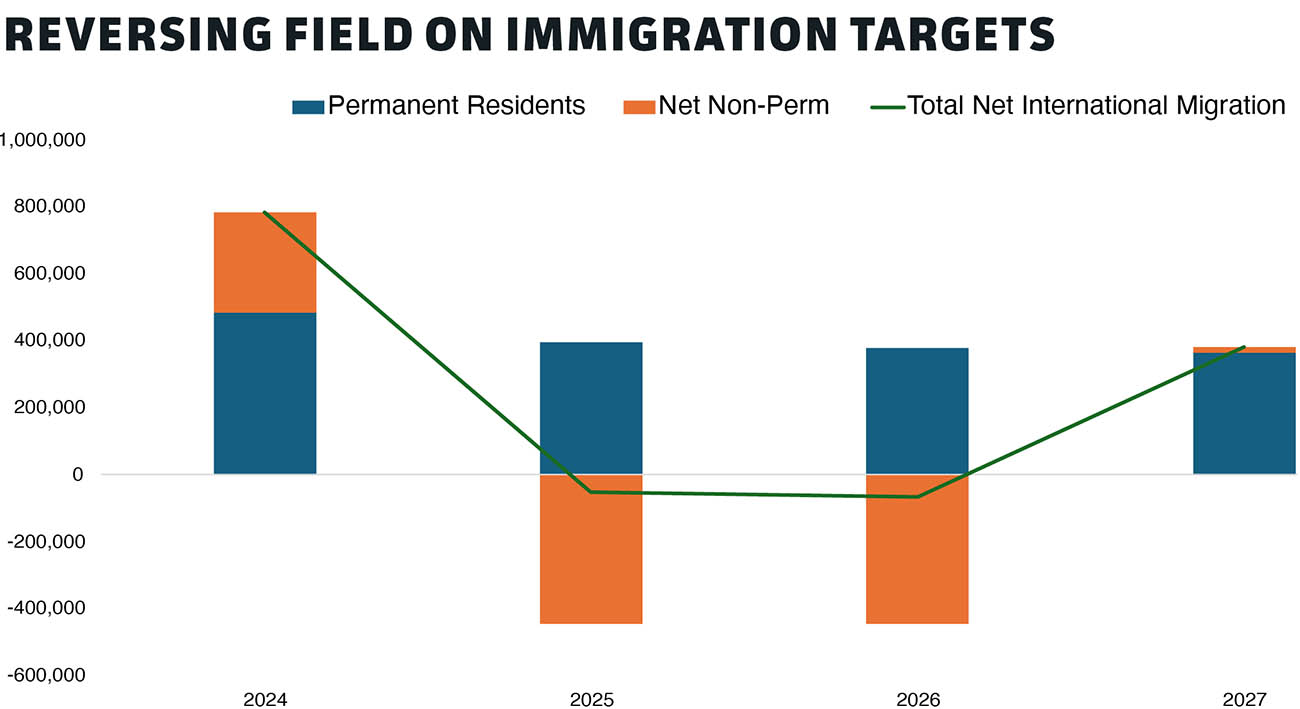
In response to those housing pressures, the government has reversed field, lowering its target for permanent residents from 500,000 per year to 395,000 in 2025 and falling to 360,000 in 2027. More dramatically, it is hoping to engineer an outflow of close to 900,000 net non-permanent residents over the next two years.
With the planned reduction in non-permanent residents, it is anticipated that this outflow will ease the demand for rental properties. However, the extent of relief on rent prices remains uncertain. While the departure of 900,000 non-permanent residents could introduce downward pressure on rents, vacancy rates are still alarmingly low. The most recent CMHC rental report found that apartment vacancy rates in Metro Vancouver remain below 1%, and vacancies have fallen in Abbotsford from 2.1% in 2022 to just 0.9% in 2023. This situation is exacerbated by the latent demand from a substantial number of people who are currently enduring suboptimal housing situations. These individuals are likely to seize any opportunity to move into more suitable accommodations, thus potentially offsetting some of the expected relief in rental pressures.
Housing supply & price impacts?
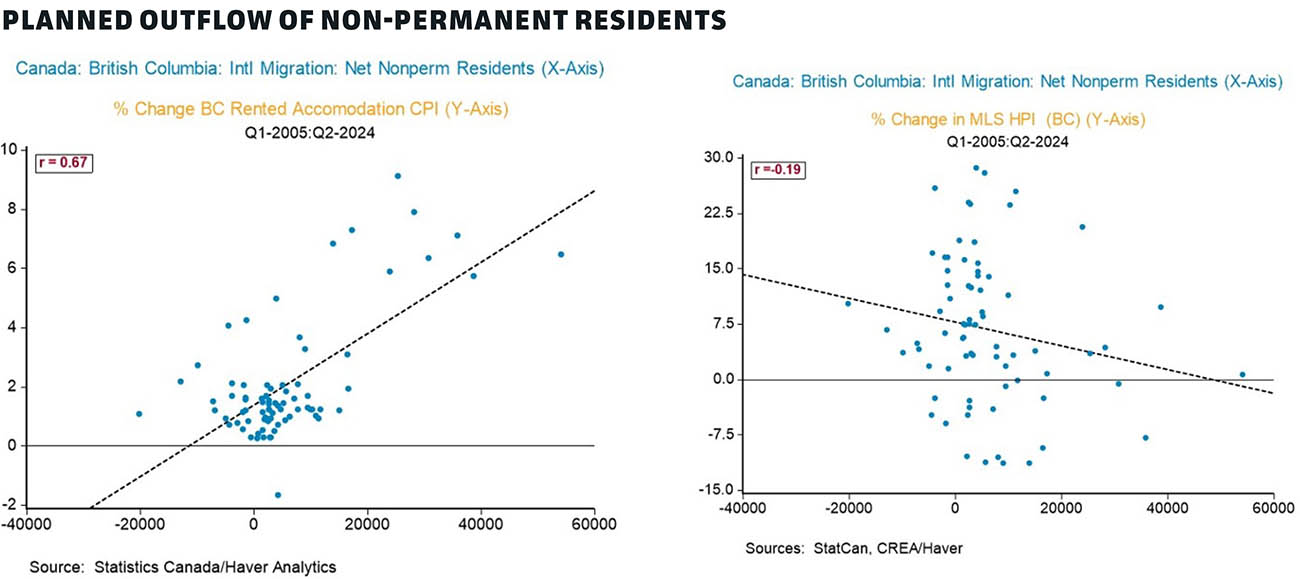
While the rental market is set to experience the most immediate impacts of lower immigration, the ownership market is not expected to remain entirely unaffected. If rent prices soften, there may be a corresponding decline in investor demand for rental properties. This shift could occur at a critical time, as pre-sale investments are crucial for funding new housing developments. A reduction in investor interest could, therefore, pose challenges to the housing supply chain, potentially slowing down the construction of new homes that BC desperately needs. However, data tells us that flows of non-permanent residents, while strongly correlated with rents, have historically had little correlation with home prices, suggesting the impact on the ownership market should be modest.
The Canadian government’s plan to reduce the population by almost 900,000 non-permanent residents is an aggressive move that seeks to undo its original error. While this policy may ease some of the current pressures on rent prices, the overall impact will be moderated by low vacancy rates and latent demand for better housing. The ownership market could also experience ripple effects, particularly in terms of investor demand and housing supply. As these changes unfold, it will be crucial to monitor and adapt to the shifting dynamics in BC’s housing landscape.

Brendon Ogmundson is Chief Economist at the British Columbia Real Estate Association.
Issue 4 | 2025 Spring

Gearing Up for Growth
Langley Township Mayor Eric Woodward Mayor is laser-focused on safeguarding the momentum to build housing and create opportunities for his constituents. And if that means challenging the status quo or the dictums out of Victoria, then so be it.
more >

No Vacancy at Any Price
The rental housing crisis has been decades in the making, but maybe the Fraser Valley will be the place to lead the recovery.
more >

Real Estate Outlook 2025
The Fraser Valley and other parts of BC are looking at a year of delayed recovery for the real estate and development sector.
more >
ADVOCACY
Offsite Construction: A Solution to Housing Woes?
Is offsite construction the solution to Canada’s long-term supply woes?
more >
Insight
Brendon Ogmundson
As We Go Up, We Go Down: The Changing Tides of Immigration in Canada
Brendon Ogmundson on the changing tides of immigration in Canada
more >
Last Word
Penny Gurstein
The Promise of Purpose-Built Rentals
Innovative solutions are needed.
more >